
Shades of Meaning
Word Meaning - Nuance & Meaning
Learning Shades of Meaning through Acting
In This Lesson
Some words have similar meanings, but each word has a slightly different meaning, like how strong or weak it is. We want to help students understand this by acting out what each word means.
Activity Prep
Download & print the PDF below (If you'd like to show it on the screen, that sounds great, too.)
How to Use
Setup:
Download and print the PDF. (or display it on the screen 💻).
Gather around. (or the screen 💻).
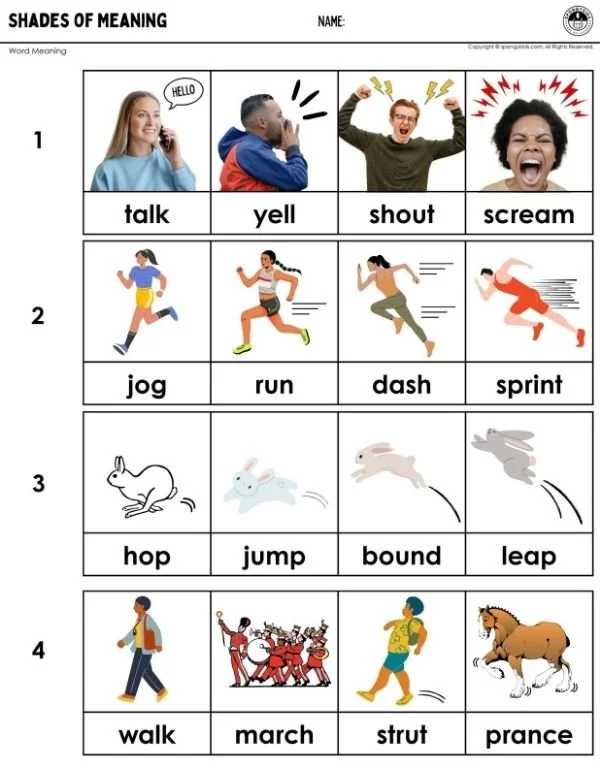
The anchor chart shows words with similar meanings but slightly different. For example, look at the images at the top. It starts with a normal speaking voice and then gets louder as you move to the right. Isn’t that interesting?
Activity:
Safely act out the differences between the words on the anchor charts.
Note
Please explain the differences between each word on the anchor chart to help guide the students in their acting.
Safety is the most important thing! When students act out, please make sure nobody gets hurt or breaks anything around the students.
If there is extra time, ask students to compare two similar words. For example, "big" and "huge" have similar meanings, but "huge" refers to something much larger than "big."
Common Core
CCSS.ELA-LITERACY.L.K.5.D: Distinguish shades of meaning among verbs describing the same general action (e.g., walk, march, strut, prance) by acting out the meanings.
CCSS.ELA-LITERACY.L.1.5.D: Distinguish shades of meaning among verbs differing in manner (e.g., look, peek, glance, stare, glare, scowl) and adjectives differing in intensity (e.g., large, gigantic) by defining or choosing them or by acting out the meanings.
⬇ Click the link below to filter for similar exercises.
